
Warwick Previous Residents by Record Era
Past residents of a Warwick address do not appear in one continuous database. The reliable method is chronological: first identify the parcel and its current record date, then follow the County Clerk's recorded instruments and use local historical sources for the era before a modern address or document trail becomes clear. Several strong sources are dated, but the dates describe their own coverage rather than a promise of full household history.
| Source | Years | Where | What it shows |
|---|---|---|---|
| Warwick final assessment roll | 2026 | Orange County parcel and final-roll routes | Dated parcel snapshot, owner-of-record and mailing fields, Deed Book/Page, and tax-map context |
| Orange County Clerk / SearchIQS | Online beginning date not verified | Paid online account or County Clerk record room | Recorded instrument and legal-description trail when the document is located |
| AWPL assessment and tax-roll holdings | 1775; 1813, 1815, 1824, 1830, and 1844 | Albert Wisner Public Library | Dated tax or land context, not an occupancy list |
| Orange County atlas | 1875 | NYPL Digital Collections | Road, lot, settlement, and named-property context for its map date |
| Village Map Name Index | 1903 | Albert Wisner Public Library | Name and map lead subject to its item and date limits |
| Orange County probate images | 1787-1938 | FamilySearch and Surrogate's Court route | Estate and property clues in browseable images, not a complete name search |
| Warwick cemetery index | 1867-1919 | AWPL genealogy resources | Burial and death leads that need confirmation through the proper custodian |
Use the roll and Clerk for a parcel chain. Use the library, archive, map, cemetery, church, newspaper, census, and probate paths for historical context. The source date should remain beside every name, road, lot, map, or instrument reference.
Warwick Parcel Snapshot Before Past Residents
Orange County Parcel Information is the first official layer for a known address. The county says its real-property route supports Owner Name, Address, Tax Map number, and Municipality searches. The 2026 final assessment roll is an open, address-sequenced fallback. It records an assessment snapshot, including a parcel's property location, owner name, owner mailing address, Deed Book/Page, and tax information.
Those fields have limits. An owner of record is not automatically a resident, and an owner mailing line is a tax-contact field rather than proof of full-time occupancy, family connection, or prior household. Record the roll year, tax-map number, property location, and deed reference before comparing any earlier source. The county's legacy Image Mate notice also excludes Warwick from its weekly-update statement, so a live portal result and the official roll deserve a date check rather than an assumption that they agree.
Warwick Previous Residents and Paid SearchIQS
The Orange County Online Records page directs land researchers to SearchIQS Online Records, an account-based service rather than a free anonymous index. The county lists one-day land-index and image access at $15, with $5 for each document printed or downloaded. It also lists 90-day plans at $150 in state and $600 out of state, with $0.50 per printed or downloaded image page. These are access and copy charges, not a title opinion or proof that a document answers a residence question.
The exact online beginning date and historical cutoff for SearchIQS were not published in readable form in the inspected official material. The account wall also prevented verification of its post-login fields, dropdowns, image controls, export behavior, or button labels. Do not claim a coverage start date. For an older instrument, a known party, book/page, map, or legal description, ask the County Clerk Record Room at 845-291-3287 about the appropriate counter or copy route.
Note: Treat a paid online index and the County Clerk record room as complementary channels, because online coverage and account controls were not verifiable from the public screen.
Warwick Deed Chains for Previous Residents
A chain of title follows recorded interests in a parcel, not a list of occupants. It begins with a supported parcel reference and proceeds through documents whose legal description and recording details match the same property. Orange County's deed guidance says an instrument includes the state, county, town or village legal description, and it may point to a previous deed. That stable legal description is usually safer than relying on a street number that may have changed form over time.
- Use the county parcel route or 2026 final roll to record the tax-map number, property location, current record date, Deed Book/Page, and owner-of-record field.
- Use SearchIQS if the account route is suitable, or contact the County Clerk Record Room with a known party, recording reference, book/page, or legal-description clue.
- Compare the found instrument's legal description, recording date, and reference with the parcel before deciding it belongs in the same chain.
- Identify the grantor and grantee on the matching document, then use the earlier deed reference or record-room assistance to locate the prior link.
- Repeat only while the legal description and dated record support the connection. Keep breaks, trusts, estates, entity names, and conflicting descriptions visible.
- Grantor
- The party conveying an interest in a recorded instrument. A grantor name does not establish where that person lived.
- Grantee
- The party receiving an interest in the instrument. A grantee can be a person, trust, or entity, so the name needs record context.
- Chain of title
- The documented sequence of recorded interests in one parcel. It is not a household roster and does not replace a professional title examination.
- Legal description
- The property description used in a deed or related record. It helps link instruments when road labels, parcel lines, or address numbers differ across time.
Warwick Previous Residents Need Dated Addresses
Warwick's address history is a local administrative quirk. Under the Town's 911 procedure, road-name matters go to the Town Clerk, a plan showing lot, house, and driveway information goes to Building, and Building assigns the address number. Planning is involved, while the Town Clerk or 911 coordinator handles the road-name designation. A road name and a street number are related records, but they are not the same record.
That distinction explains why a County map, a recorded subdivision, a Building Department file, a parcel roll, and a historic atlas can label the same area differently. Test the road spelling, hamlet or village attribution, road orientation, legal-description clue, and source date before treating two address forms as one place. No authoritative public Warwick road-renumbering list or online historic address index was verified, so old street names and former numbers should not be invented.
For a defined address, plan, permit, certificate, or road-name record, the Town Assessor, Building Department, or Town Clerk can explain the right local channel. A narrowly described Town FOIL request may seek an agency record. It does not replace the County Clerk's land-record procedure or create an online historic-address index.
Warwick Tax, Map, and Cemetery Leads
Historical alternatives help when a deed trail reaches a date or description that no longer looks like a modern address. AWPL identifies a 1775 Orange County assessment roll, an 1810 census index, town tax rolls for 1813, 1815, 1824, 1830, and 1844, Old School Baptist Church resources dated 1765-1830, and a cemetery name index for 1867-1919. It also names obituary and biographical indexes. Each resource can establish a time-and-place lead, not a full resident history.
The 1875 atlas is particularly useful for Warwick Village, Pine Island, Edenville, New Milford, and Amity. The 1903 Village Map Name Index provides a later local map lead. Compare a historic plate with a parcel, map, deed, or tax reference only after checking orientation, locality, and date. A familiar road name may have shifted in scope or alignment.
At the end of a dated trail, obituary, cemetery, church, and vital-record material can supply a family or death lead. Town and state vital certificates have access and eligibility rules. The local genealogy and custodial routes should be used without republishing restricted certificate details.
Warwick Previous Residents from 1775 to 1903
Albert Wisner Public Library's Warwick Valley History guide points researchers toward local history and genealogy paths.
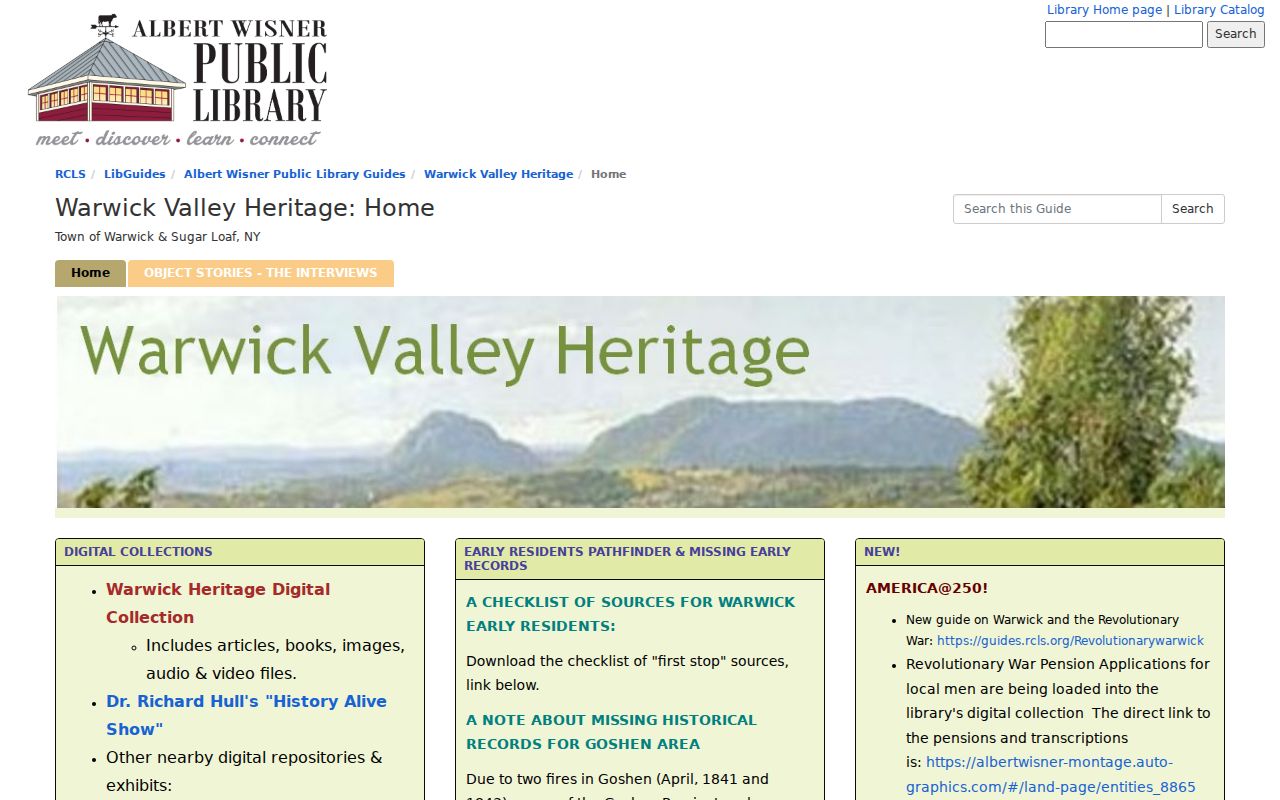
The guide is a discovery route, not a verified searchable address directory. Its final research inspection was rate-limited, so unobserved database tabs and filters are not described. Ask AWPL for an exact item, year, place label, or source format. The library and the Warwick Historical Society can also clarify whether a local file, map, archival item, or print source is available in person.
A short chronology helps keep records in order: 1775 assessment evidence; 1813, 1815, 1824, 1830, and 1844 tax-roll evidence; 1875 map geography; and the 1903 Village Map Name Index. Each date marks a source, not a statement that a person remained at a place between the records.
Warwick Probate Images for Previous Residents
FamilySearch's Orange County probate collection covers 1787-1938 and reports 1,418,123 images. It is an image-first collection, not a fully indexed name search. Begin with a date range, surname, cemetery or obituary clue, tax evidence, or known estate context. Then confirm the county, court, volume, and image before treating a probate packet as relevant to a parcel or family.
Once opened, an image may contain a decedent name, estate title, petition date, executor or administrator, beneficiary or heir references, guardianship references, property description, signatures, witnesses, or volume and page navigation. Those are possible fields, not a promise that every packet contains each one. A miss in a name index is not a miss in this image collection.
Originals, certified copies, or a current estate file belong with the Surrogate's Court clerk. Sensitive and adoption materials have separate restrictions. The public collection's access conditions can change, so confirm access at the collection page before relying on a viewing route.
Warwick Previous Residents: Household Evidence
Ownership is only one layer in house history. A dated census, church resource, cemetery index, obituary, probate packet, or a verified directory volume can add a different kind of household evidence. Pair sources by date and place. Do not turn a tax or deed name into a claim about every person who lived at the property, and do not assume an old map address is the present street number.
For a potential historic directory volume, the Warwick city-directory collections route keeps the collection question separate from the parcel chain. When an item is located, preserve its title, year, publisher if printed, locality coverage, and the exact information shown. An unlocated city directory, a map index, and a probate image are different forms of evidence.
Note: An unresolved name, date, place, or legal-description conflict should stay unresolved until a dated original record supplies the missing link.