
Warwick Directory Collections and Alternatives
No authoritative digitized Warwick city-directory run was verified in the inspected Albert Wisner Public Library, Warwick Historical Society, NY Heritage, or NYPL sources. That is a meaningful result, not an invitation to attach a publisher, date range, reverse-directory section, or entry format that has not been seen. The local record trail remains strong, but it is a set of dated alternatives. Ask a custodian about an exact year, title, address, or surname, and keep the original item and its date attached to any conclusion.
| Collection | Years | Where held | Access |
|---|---|---|---|
| Digitized Warwick city-directory run | No verified run | None located in the inspected local and digital sources | Ask AWPL or the Historical Society whether a specific title survives |
| AWPL genealogy holdings | 1775; 1810; 1813, 1815, 1824, 1830, and 1844; other dated items | Albert Wisner Public Library | Genealogy page, local-history desk, and staff inquiry |
| Village Map Name Index | 1903 | Albert Wisner Public Library | Named map-index lead; inspect the item and date context |
| Atlas of Orange County, New York | 1875 | NYPL Digital Collections | Digitized map viewer; a geographic source, not a directory |
| Warwick Historical Society archive | Dates vary by item | 80 Main Street archive and digital-archive gateway | Archive appointment and online collection gateway |
For a person before the twentieth century, the 1775 assessment roll, the 1810 census index, town tax rolls, church material, cemetery indexes, and local obituaries may answer a narrower question better than a missing directory. For a place, the 1903 map index and 1875 atlas can put an address question into its period. Each source has a different scope.
The Warwick Digitized-Directory Gap
Warwick is a town, not an incorporated city, and the record trail can appear under Warwick, Village of Warwick, Florida, Greenwood Lake, a hamlet, a parish, or a postal label. The research did not verify a digitized title, publisher, year span, or sample page for a Warwick city directory. It also did not verify a local reverse or criss-cross run. A claimed directory result should therefore be treated as unconfirmed until a librarian or archivist identifies the actual volume or file.
Historic newspapers can add date-bounded notices, obituaries, social items, advertisements, or events, but availability and terms vary. The library guide or collection staff can identify a title and date before a snippet is used as evidence. Federal population schedules are another dated source. The 1950 census is the latest released public population census, and it records the enumeration date rather than a present address.
Warwick Local-History Collection Route
Albert Wisner Public Library's genealogy page identifies local tax, census, cemetery, church, obituary, and map leads. The library's Warwick Valley History guide gives another local starting point, although its live guide response was rate-limited during final research, so unobserved database tabs or filters are not claimed here. Call AWPL at 845-986-1047 with the year, locality, and item type in hand, then ask about availability or a shelf, file, or collection location.
The Warwick Historical Society archive is an appointment-based route for local manuscripts, maps, photographs, objects, and collection context.
Its archive and digital-archive gateway can help identify a local source, but the inspected material did not establish a digitized Warwick city-directory run. Requesting a particular date, address, collection, or title is more useful than a broad name search.
Online discovery does not replace the counter. AWPL, the Historical Society, Orange County Clerk, and the Surrogate's Court clerk are the practical in-person channels for originals, folders, land context, or estate records. Town or County FOIL can seek a defined agency record, but it does not require libraries, private historical societies, courts, restricted vital files, or protected archival material to become public.
Warwick Map Sources for Directory Searches
The verified 1903 Village Map Name Index is a concrete local lead, not a complete street-address directory. The 1875 NYPL atlas of Orange County includes plates for Amity, New Milford, Edenville, Pine Island, and Warwick Village. It can show a road spelling, settlement context, lot name, or neighboring feature as of its map date. It cannot silently turn an 1875 lot label into a modern mailing number.
The NYPL atlas item provides a digital view of that dated geography.
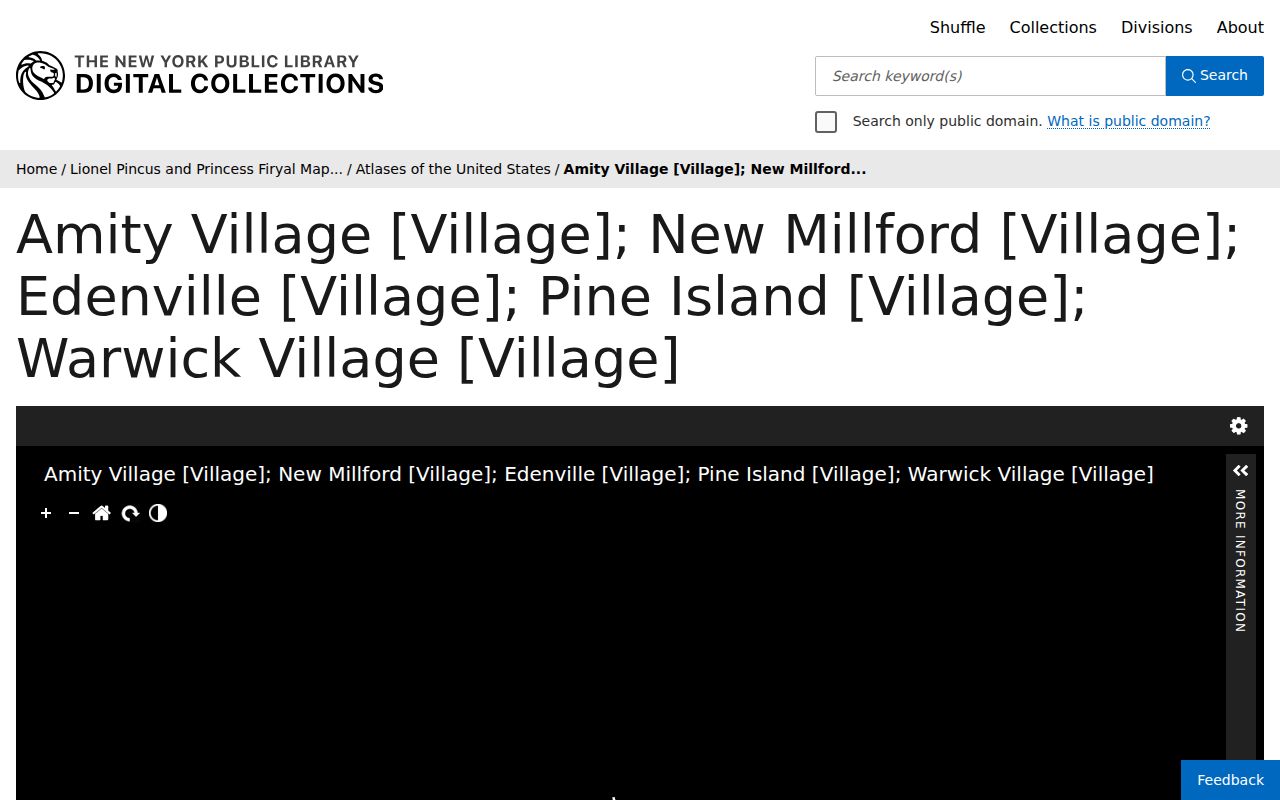
The atlas is most useful when paired with a tax-map number, legal-description clue, or later recorded map. Modern assessments, 911 addressing, village or hamlet labels, and historic maps are separate time layers. A source that appears to disagree may be describing the same place at a different time.
Note: Keep the map year beside every road, lot, or surname lead so that historic geography is not mistaken for a current address.
What a Warwick Directory Item Can Prove
A real historic directory can only be described after the item itself is identified. No Warwick directory sample was verified, so no actual entry fields, abbreviations, owner marks, spouse notation, occupation column, or page layout can be promised. Use the inventory as a checking tool for a source that a librarian or archivist produces. It deliberately does not describe a Warwick entry as though one had been inspected.
| Item detail to inspect | Confirm whether the title, publication year, publisher, and place coverage are printed on the item. |
|---|---|
| Name treatment | Record the spelling exactly, including initials or suffixes, rather than expanding a name from another source. |
| Address or place label | Determine whether the item gives an address, village, hamlet, rural route, or no location at all. |
| Household or occupation detail | Only transcribe a relationship, occupation, or business description if it appears in that item. |
| Symbols and abbreviations | Photograph or copy the volume's own key before interpreting a mark. |
Owner names on a tax record, a probate party, and a cemetery index each describe their own record event. They are not substitutes for a directory entry, and a shared surname is not enough to combine them into one household.
Warwick Directory Terms Without Assumptions
Historic research uses useful shorthand, but terms must not be used to invent a Warwick volume that the research did not find. These definitions help frame a request and preserve that boundary.
- Criss-cross directory
- A directory arranged by address rather than by name. No Warwick criss-cross run was verified, so do not assume one exists for a selected year.
- Householder index
- A name or household arrangement within a record. A holding should be inspected before calling any Warwick item a householder index.
- Abbreviation key
- A legend supplied by a specific publication. Warwick abbreviations must not be invented or borrowed from another publisher's volume.
- Source date
- The date the map, roll, census, record, or directory was created. It defines the time the source can support.
Where an address is the starting point, Orange County's parcel and land records can supply a modern tax-map or deed reference. They are a separate current-record route, not a reconstruction of a historical city directory.
Trace a Warwick Household by Date
Household tracing works best as a dated sequence. Start with a confirmed surname, place label, or parcel clue. Use the oldest source that directly fits the question, then compare it to a second record from the same period or a nearby one. A disappearance can mean a move, death, variant spelling, changed place label, or simply that a source does not list the person.
- Choose a date range and decide whether the question is about a person, a parcel, a church community, a burial, or a local map.
- Check the AWPL 1775 assessment roll, 1810 census index, dated tax rolls, church resources, cemetery material, or obituary indexes that fit that range.
- For a place question, compare the 1875 atlas and 1903 Village Map Name Index with the road orientation and locality in later records.
- Pair a released census with its enumeration date, then look for a tax, cemetery, obituary, or probate lead that tests the same surname and place.
- Keep competing spellings, dates, and locality labels visible until an original item resolves them.
The National Archives census research route provides federal census context. Use the period label on each record, not an undated conclusion about where a family lived.
Warwick Record-Keeping Dates
Warwick's local geography explains why an item can be filed under a village, town, hamlet, parish, or county label. The Town records a 1764 settlement date for the Village of Warwick, a railroad opening in 1862, and village incorporation in 1867. These dated sources are research anchors, not a continuous directory chronology.
| 1773-74 | AWPL identifies Baird Tavern material. |
|---|---|
| 1775 | AWPL identifies Orange County assessment-roll material. |
| 1813, 1815, 1824, 1830, 1844 | AWPL names Warwick tax rolls. |
| 1867 | Village incorporation and the beginning date of AWPL's cemetery index period. |
| 1875 / 1903 | NYPL atlas and AWPL Village Map Name Index give dated geography and name leads. |
These dates create a practical comparison: maps show geography, tax rolls show dated tax or land context, cemetery and church sources can identify family events, and a census or probate file may supply a household or estate connection. None should be widened beyond its own date and scope.
Warwick Archive Requests for a Directory Year
Lead with a narrow request: the year, the place label used at that time, an address or road if known, and the type of source sought. AWPL and the Historical Society can confirm whether a cataloged print volume, vertical file, map, newspaper, local-history resource, or digital item is available. A phone or email inquiry should seek availability and access procedure, not ask staff to create a resident list from scattered material.
The NY Heritage Warwick collection and the library's local-history sources provide online discovery points. For a defined government-created map, permit, or local file, New York Freedom of Information Law, Public Officers Law art. 6, sections 84 through 90, supplies a request route, subject to exemptions and the separate rules that govern court, vital, library, and archive records.
Note: State the collection name, item year, and access question when contacting a custodian, because a broad directory request hides the detail needed to locate material.